Are serviced offices set to dominate the London occupational market?

It is the topic of conversation amongst most of the West End
and City office agents, but are they embracing change?

It cannot be denied that the sector has expanded rapidly over
recent years. The market has matured substantially from its origins
where the only occupiers tended to be start-ups that couldn’t
afford a ‘proper’ office and needed not much more than a postal
address. The UK is now the leading global serviced office sector
accounting for 36% of worldwide serviced office footprint and a
growth rate of 31% since 2008. As might be expected, London is
leading the way accounting for 34% of the UK market since 2008*.
For the first half of 2017, the sector accounted for 9% of take up
in the City and 8% in the West End, which is in part due to the fact
that tenants are increasingly prepared to pay the ‘premium’ rents
associated with serviced offices in return for greater flexibility and
the advantages of fixed costs without the potential risks associated
with a conventional lease.

Clearly, flexibility and minimal start-up costs are key factors,
especially for the smaller occupiers, but these are not the only
reasons for growth in the sector. Larger occupiers are also attracted
to co-working and serviced offices where they see the opportunity
to collaborate with the new and creative companies that dominate
these centres and the access it gives them to a growing talent pool.
We don’t view the sector as a threat; on the contrary, we see the
fluidity and flexibility as a complement to the more traditional
leasing model giving our tenant clients greater choice. To that
end, we have enthusiastically embraced the sector and are actively
assisting a number of the major operators with their ambitious
growth plans.

Recently, we advised Prospect Business Centres on their acquisition
of approximately 17,000 sq ft at 20 Midtown on Proctor Street, WC1.
Prospect informed us that Midtown was an area of interest and
having identified 20 Midtown as an ideal building we negotiated
terms on their behalf and as a result they will shortly be opening
their first Midtown centre.

Some landlords express concern over covenant strength with the
majority of operators taking leases in an SPV with additional surety,
usually in the form of a limited parent company guarantee. But long
gone are the days of Ouvagh Highfield and Southern Cross and there
have been few operator failures in recent years.
Also, and of increasing importance in these uncertain times, they are
more than happy to sign up on long term leases, in fact, this is their
preference with a minimum term of ten years required in most cases.
So the message is whether acting for landlords or tenants, we have to
“Larger firms and corporates view these adapt to and adopt to the ever-changing occupational office market

Retail Rent Reviews a Plenty on City Road

Kinney Green’s Professional Department has been instructed to advise on three retail rent reviews on City Road, EC1.

The three units are all within the Lexington Building on City Road which is in close proximity to Old Street Roundabout or Silicon Roundabout as it has recently become known due to its popularity with web and mobile app companies. The area is currently undergoing something of a mini-regeneration with The White Collar Factory development by Derwent London and The Bower Development by Helical Bar both under construction.

The units are tenanted by Subway, Cafe Nero and Abokado.

77-95 Victoria Street, London, SW1 – Rent Review

We are delighted to announce that Kinney Green has been successful in winning the mandate to advise the landlord of 77-95 Victoria Street, SW1 on the June 2016 rent review.

The rent review will involve approximately 43,200 sq.ft of office accommodation arranged over basement to seventh floor. 77-95 Victoria Street is an 8 storey 53,000 sq ft office and retail building constructed in the 19th century. The building occupies a corner position on the south side of Victoria Street at its junction with Parliament Square.

A Growing Professional Team

We are pleased to welcome Luc Griffiths to our professional department.

Luc has recently finished an MSc in Real Estate Management at the University of the West of England, Bristol, having previously studied BSc Geography & Planning at Cardiff University.

Luc says, “I am tremendously excited to join a fantastic team here at Kinney Green, and really looking forward to embarking on the APC process in the coming weeks.”

EU Referendum – Should we stay or should we go now?

2016 shows no sign of easing in respect of the continued lack of supply of commercial accommodation in London. Demand continues to put pressure on rents and considerable increases at review or renewal are commonplace. Early consideration is essential due to likely competition in the marketplace and professional advice is vital.

The effect on capital values is also apparent as for the time being, the general economist’s view is that a Brexit is likely to dampen prospects for commercial real estate, though in the short term yields have remained stable. However, if the country decides in favour of a Brexit on 23rd June the prolonged uncertainty during the exit negotiations may impact considerably and negatively on investor sentiment.

Careful consideration of the strategy of reviews and lease renewals for all types of property it is essential as the effects could be long term and have further reaching affects against potential market changes and negotiations in consideration of value of both leasehold and freehold is paramount. Kinney Green is able to offer a thorough understanding of the current market with an analytical approach to the evidence, in relation to specification, location and lease term to ensure the best outcome for our clients.

The Minimum Energy Efficiency Standards (MEES) will become effective on 1 April 2018. As a landlord or tenant do you know what issues could affect you?

The Minimum Energy Efficiency Standards (MEES) will become effective on 1 April 2018. As a landlord or tenant do you know what issues could affect you?

It is clear MEES could have significant impacts for both landlords and tenants on lettings, valuations, rent reviews and lease renewals. We highlight below a few points to give thought to but firstly a quick reminder of what we’re dealing with.

The Energy Act 2011 first introduced the MEES regulation, which stipulates a non-domestic property with an EPC cannot be let if F or G rated after 1st April 2018. Furthermore, in 2023 all properties with an EPC, whether being let or not, will need to comply. There are some exclusions to MEES, such as lettings under 6 months or listed properties.

A lease renewal under the 1954 Landlord and Tenant Act entitles a tenant to a lease on similar terms to the existing lease. The valuation assumptions are different to rent reviews but should existing case law be applied to MEES compliance this could have a valuation impact on renewal. The disregard of tenant’s improvements under section 34 could result in further valuation complexities if those improvements achieved MEES compliance.

Having a clear idea on where your property stands and what negotiation arguments could be brought to the table and potential solutions is vital.

The onus is on the landlord to upgrade the property through cost effective Relevant Energy Efficiency Improvements (REEI) that must be implemented prior to letting.

Introducing mandatory regulations to improve a property’s energy efficiency is at face value a good way forward to future proof the UK’s building stock and a tool for contributing towards carbon emission reduction targets.

We are in favour of the introduction of such initiatives and the medium to long term view should result in building energy cost savings as well as a reduction in greenhouse gases. As with all new regulations, however, once you start looking at the logistics there are some potential ramifications. There are arguments that the regulations could affect rental values at rent review or lease renewal and therefore, all things being equal, capital values and possibly future yields.

A couple of lease issues to bear in mind:

A rent review at or beyond 1st April 2018 will make certain assumptions on the ‘hypothetical letting’, one of which will be whether tenant’s improvements should be disregarded.

It is quite possible that the property only achieves an energy efficiency rating of E or below because of tenant’s improvements, for example, on building services and new LED lights. Therefore, if improvements are disregarded that fact potentially renders the hypothetical property unlettable in its existing state. Also, can the property be assumed to be ‘fit and available for immediate occupation’ if the required level of EPC is not in place? There are existing recedents that could be extended to apply to MEES compliance. The cost of such improvements could be taken into account at review, and case law and time will judge what becomes accepted. There is an argument that rent reviews before the compliance date, for terms extending beyond, will also reference the requirement as a factor.

A few points to think about:

1. The current EPC rating is key to any future works required and potential lease negotiations. Have you considered the EPC ratings for your properties and are the EPCs robust enough to be scrutinised and verified? Ensuring you have accurate EPCs with all the background data is essential as a first step for any negotiations.

2. Were tenant’s improvements responsible for lowering the EPC to E or better and do both parties have all the necessary documents and consents in place?

3. Is your property E rated? It could slip over the threshold into an F due to future Building Regulations introducing enhanced energy performance requirements. An EPC calculation is dynamic and refers to current Building Regulation requirements. Therefore, future changes to the regulations could see your property move to an F. Plan to future proof these buildings.

4. Are you clear what constitutes an REEI? Can it be implemented as part of a planned maintenance programme?

5. Have you considered the potential impacts for a rent review or lease renewal? Are there break clauses coming up where these regulations may be used for negotiation?

6. Are there any REEI exclusions that apply, for example, are there reasons why consent to any works would not be available or could any REEIs actually devalue a property?

7. As a tenant is it possible you will become a landlord in the future due to a subletting? You will need to consider these regulations in that context.

Two years or 24 months may seem a long way away but the clock isticking to fully consider each property, either owned or occupied, that may be in scope and then plan for the improvements and outcomes.


New addition to the Kinney Green team

John Nguyen has joined Kinney Green to further develop our strong management services offer. John has spent the last 2 years at Cushman and Wakefield within the Global Occupier Services team managing a number of property portfolios with high profile clients such as Royal Mail, Pizza Hut, KFC and City Link.

Prior to this, John spent 2 years at Colliers International in Melbourne, Australia as an assistant Valuer, valuing various properties within the industrial, commercial and retail market, however predominately specialising in office buildings.

We are delighted to welcome him to the team and his contact details are below.


Kinney Green delighted to provide asset management services at 10 Old Bailey, EC4M

Kinney Green have been instructed on a mandate to provide asset management and consultancy services alongside Anglo Fortune Capital Group at 10 Old Bailey, EC4M.

We will seek to proactively identify and deliver strategies to maintain and enhance 10 Old Bailey which is a 72,000 sq ft high quality office building located on the eastern side of Old Bailey and occupies a site bounded by the Central Criminal Court (the ‘Old Bailey’ itself) to the north, Amen Court (the official residence of the clergy of St Paul’s Cathedral) to the east and 5 Old Bailey (a 1970’s office building) to the south.

600,000 Small Businesses Benefit from Business Rates Break

Small business have today welcomed the Chancellor’s 2016 Budget, business rates reforms increasing the threshold for 100% business rates relief from £6,000 to a maximum of £15,000. The implication of this is that 600,000 small firms will pay no business rates from 1st April 2017.

The Chancellor also announced that the threshold for benefitting from the Small Business Rates Multiplier will be increased from a rateable value of £18,000 to £51,000.

This will mean that another 250,000 businesses will pay lower business rates from 1st April 2017.

We would urge you to review your current 2010 Business Rates assessment as your current Rateable Value will most certainly have an impact on your 2017 rate liability.


Valuing in the Hypothetical World

Nick Eden delivered a talk “Valuing in the hypothetical world” at the Index Conference at Warwick on 8th March attended by over 100 people comprising surveyors and lawyers. He delivered the talk and a Q and A session afterwards with Zia Bhaloo QC of Enterprise Chambers.

The thrust of the joint talk was perspectives on value and the framework of assumptions within which value should be applied to ensure a reliable valuation result.  The principal messages were that the market is king and that assumptions which are made should be realistic and not numerous. It was emphasised that case law should be used with care as often valuation related cases turned on particular circumstances and may not be applicable across the board.

2016 Index Conference

Kinney Green confirms that Nick Eden, Consultant, will be speaking at the 2016  Index Conference on 8th March at the Ardencourt Manor Hotel, Warwick. His talk is “Valuing in the Hypothetical World” which he will be presenting jointly with Zia Bhaloo QC of Enterprise Chambers, Lincoln’s Inn.

Discussions will cover, Economic Review & Prospects, Code of Measuring Practice, Valuing in the Hypothetical World, Dealing with Uncooperative Parties, Costs & Offers to Settle and Case Law Update

The speakers also include:- Simon Durkin – BNP, Zia Bhaloo QC – Enterprise Chambers, Tasmin Cox & Nat Duckworth – Falcon Chambers, Emma Humphreys – Charles Russell Speechley, Max Crofts – JLL, Dr John Fletcher – Dispute Resolution Service RICS

Councils in England predict a £400 million increase in Business Rates income next year

With the 2017 Rating Revaluation fast approaching, the government has predicted that Councils across England will make a record-breaking income of about £23.5 billion from business rates next year; an increase of about £400 million. The local government minister Marcus Jones attributed the increase to a rise in the number of new businesses across the country as figures show that there are 900,000 new businesses now than in 2010.

However, the Confederation of British Industry have warned that the burden of rates payments, coupled with the apprenticeship levy and the living wage, could cripple companies over the next five years.

The government has introduced more than £1 billion support for business rates bills in 2015 to 2016 and have confirmed that the doubling of Small Business Rate Relief will continue into 2016 to 2017. In total, councils already plan to hand out £3.2 billion to charities and business through mandatory and discretionary allowances/reliefs.

Under the current rating legislation, which was introduced in 2013, councils in England are allowed to keep 50% of business rates income they generate for themselves, paying the other 50% to the Treasury. From 2020, this will be changed to allow them keep 100% of the business rates they collect.

From 2020, councils will also have the power to abolish the uniform business rate (UBR), allowing them to cut rates to stimulate growth in their local areas and attract new businesses.

We would advise that with this constantly growing overhead, it is even more important to review you current rate liability. If you have not already considered a review or rate ‘check-up’ please revert to us.

Rating Revaluation 2017 – Fast approaching!

As we eagerly await the delayed Revaluation, the Valuation Office Agency confirmed on 1st February that the draft Rating List for the 2017 Revaluation will be published in September 2016. To be notified of your new assessment at the earliest opportunity you will need to register now

https://www.gov.uk/guidance/revaluation-of-business-rates


As all owners/occupiers will be affected by the 2017 Revaluation, we would urge you to review your current 2010 Business Rates assessment (if you have not already) as your current Rateable Value will most certainly have an impact on your rate liability for 2017 – 2022.

Can we can register on your behalf?


Read more here – Rating Revaluation 2017

Kinney Green – The Conduit to Success

We are delighted to announce that Kinney Green have successfully let the last remaining floor at 21 Conduit Street, W1.  Apperly Estates, who have owned the property since 1923, undertook a comprehensive refurbishment of the building, situated on one of the most prestigious streets in Mayfair, to provide approximately 4,000 sq ft of Grade A boutique office accommodation behind a retained period façade. Kinney Green’s West End Office Agency team were instructed to let the first to fourth floors, ranging from 800-1,000 sq ft. 

All four floors  were let within six months of completion of the works to a variety of occupiers at some of the highest rents ever achieved in Conduit Street. David Apperly, Chairman of Apperly Estates Ltd, comments, “Kinney Green secured very quick lettings of these high quality floors on good lease terms and at rents well ahead of our projections. There was competitive rental bidding for the final floor between a French property company and an Icelandic Fund Manager”  

For further information please speak with Kevin Kemplen or Henry Brewster on 020 3691 6060.

West End market experiences an Indian summer

Our West End office is pleased to report a spate of transactions completed immediately after the summer period which sets the tone for the rest of 2015 and on into 2016.

Advised by Kinney Green, Biotechnology Company Silence Therapeutics, has recently moved into their new offices in Hammersmith. We were originally appointed at the back end of 2013 to advise the client on relocation, but after undertaking a detailed review of all options, the best course of action was for the client to renew their existing tenancy on a short-term basis and postpone the move.

Even though the Hammersmith market remained tight with limited supply, specially for units under 10,000 sq ft, we were able to successfully agree terms to take the seventh floor at 72 Hammersmith Road, W14, providing approximately 4,500 sq ft. The rent agreed reflects £43.50 per sq ft, an extended rent free period was granted to enable Silence Therapeutics to undertake an extensive fit-out of the floor to ideally suit their specific requirements.

Tim Freeborn, Finance Director and Company Secretary at Silence Therapeutics commented, “I’m glad we picked Kinney Green to help us find a new office. It was quite a restricted brief but they still managed to show us a good selection and they were flexible when our requirement changed during the search.”

Do you measure up?

A replacement of the Code of Measuring Practice 6th Edition is set to come into force on 1st January 2016.


The code will be replaced by “Professional statement: office measurement, being Part 1 of RICS property measurement 1st edition May 2015” to bring a global standard for the measurement of offices, followed later for retail, residential, industrial property and land.

IPMS (International Property Measurement Standards) will replace Gross

External Area (GEA), Gross Internal Area (GIA) and Net Internal Area (NIA) becoming IPMS 1, IMPS 2 and IPMS 3 respectively. 

The differences include:

GEA/IMPS 1: Comparable, however balconies and roof terraces will be included.

GIA/IMPS 2: Areas occupied by windows are measured to the glass if the area of the window covers more than 50% of the wall.

NIA/IPMS 3: Columns are included; partitions on multi tenanted floors are measured to the middle of the partitioning.

The new standards will be mandatory for all RICS members.

It is yet unclear whether properties need to be remeasured to fall in line with the new standards for say the 2017 Rating Revaluation.

Rating Revaluation 2017 – Be prepared!

In October 2012, the Government postponed the next business rates revaluation from 2015 to 2017. This decision was based on the desire to keep rates bills increasing by the rate of inflation year on year and to avoid unexpected hikes in rate liability.

However, in reality this will delay the much needed rebasing of rateable values which are currently fixed to ‘pre-recession’ rental levels in April 2008. In the vast majority of cases ratepayers would have paid significantly less in the ‘delayed’ 2015 revaluation as based on rental levels in April 2013 which in most cases will be lower than rental levels in April 2008 when the market was at its peak.

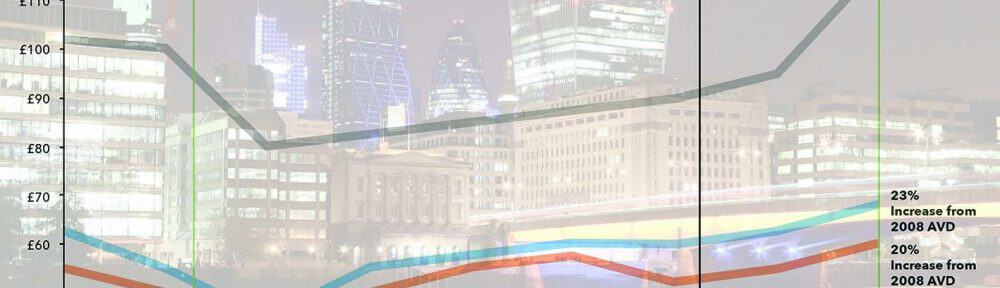
The 2017 Revaluation will be based on rental values at the Antecedent Valuation Date (AVD) which the government has set at 1st April 2015. The implication of this is that as rents have started to recover following the recession, rental value at the April 2015 AVD will be much higher than what would have been the April 2013 AVD, thereby significantly increasing the 2017 rateable values of most properties.

This delay in Revaluation heightens the importance for businesses to make sure their current rateable values are correct as with the likely reintroduction of transitional relief this could have a longer effect on your liability where calculated with reference to the rates paid in the previous year and subject to annual inflationary increases.

New values are likely to be published this time next year but we would welcome providing an appraisal now if you have not yet considered this potentially growing liability. With the valuation date being so recent, if you are in discussion on a rent review or lease renewal or have received a form of return we would advise taking advice as the implications could be significant for the next seven years!


Elsie Osunbor LLB

Business Rates Consultant & Research Analyst
Tel: 020 7643 1525
Email: e.osunbor@kinneygreen.com


New addition to the Kinney Green Management team

Bindi Buttar has joined the property management department at Kinney Green as an Associate Partner. Bindi has over 28 years’ experience within the commercial property sector predominantly focusing on City and West End assets.

Prior to joining, Bindi worked on behalf of institutional pension funds, international investors and owner occupiers. The main focus being to provide a hands on management approach, building tenant relationships and to ensure asset growth and value enhancement of client's investments. 

We are delighted to welcome him to the team and his contact details are below.

Ice Cool Settlement

The Kinney Green professional department has recently settled a compensation claim on behalf of a long established Brixton Nightclub which was to be Compulsory Purchased as part of the ‘Your New Town Hall” redevelopment by Lambeth Council. 

The ‘Your New Town Hall’ project is part of the Lambeth Council plans to regenerate a core 2.5 acre site around the Town Hall in Brixton between Acre Lane and Brixton Hill. 

The professional team engaged with the client early in the process to provide strategic advice which is essential in the build up to and when faced with compulsory purchase powers. 

Through this early dialogue the team were able to understand the clients business and aspirations and approach the assessment of compensation in a structured and justified way with the acquiring authority to enable early settlement before the Council made the Compulsory Purchase Order.

This project is just one of many Compulsory Purchase schemes Kinney Green is involved in. Should you wish to find out more about our CPO service then please do not hesitate to contact a member of the professional department. 

Another Management Instruction!

After several years of seeking a central City freehold with a ground floor banking  hall, Kinney Green identified 45/47 Cornhill in behalf of Ziraat Bank. We then negotiated the purchase of the building in an off-market transaction.

Kinney Green  have now also been instructed  to manage the building . The building which is arranged over ground and first –sixth floors will  need substantial modernisation.

CERN’s Monumental Purchase!

Hot on the heels of their purchase of 10 Dean Farrar Street SW1 in December the CERN Pension Fund completed their purchase of Monument Place, 24 Monument Street EC3 on 16th March.

This 80,000 sq ft landmark building, situated next to Christopher Wrens’ monument to the great fire of London, is the jewel in the crown of CERN’s European property portfolio and confirms their continued commitment to the London commercial property market. The building was completed in December 2013 and following fierce competition from prospective tenants is now almost fully let.

As with all of CERN’s acquisitions to date, Kinney Green assisted throughout the due diligence phase pre-purchase and have been instructed to undertake the ongoing management of this prime asset.

For similar focused acquisition advice at partner level contact Stephen Griffiths or Jonathan Burt.